You know that frustrating feeling — standing in front of a full closet and somehow having nothing to wear? Nine times out of ten, the problem isn’t that you need more clothes. It’s that your pieces don’t speak to each other. The secret to fixing it isn’t another shopping spree. It’s your capsule wardrobe color palette: a small, intentional set of colors that lets every top go with every bottom, so getting dressed takes two minutes instead of twenty.
I learned this the hard way. A few years ago my closet was packed — trendy tops in random colors, pants in every wash, shoes that matched exactly one outfit. When I finally stripped my wardrobe down to a handful of pieces in a deliberate color family, something clicked. Suddenly everything matched, and I loved my clothes again.
This guide will walk you through choosing a capsule wardrobe color palette that works for your life, your skin tone, and your style — no fashion degree required.
Why Your Capsule Wardrobe Color Palette Matters More Than the Pieces
Here’s the math that makes a capsule wardrobe work. If you own 10 tops and 6 bottoms in colors that all coordinate, you have up to 60 possible outfits. But if those tops and bottoms are in random colors that clash, you might only have 12 or 15 combinations that actually look good. The pieces didn’t change — only the palette did. Cohesive color is what turns a small closet into a large wardrobe.
The best part? Once your palette is set, shopping gets easier too. It becomes your personal buying filter — fewer impulse purchases, fewer pieces that sit unworn with the tags still on.
The Simple 3-2-1 Formula for Picking Your Palette
Don’t overthink this. The most reliable approach is what stylists call the 3-2-1 formula:
- 3 neutrals — the workhorses that make up about 70% of your closet
- 2 accent colors — the personality pieces that keep things interesting
- 1 wild card — a pattern or a bold shade you love, used sparingly
That’s it. Six color families total, and your capsule wardrobe color palette is done. Every piece you buy or keep should fit into one of these slots. If it doesn’t — if it’s a random neon green top that matches nothing — it goes in the donate pile, no guilt.
Why does this work so well? Because neutrals all play nicely together, and when your accent colors are chosen to complement your neutrals, everything plays nicely together. It removes the guesswork completely.
How to Choose Your Three Base Neutrals
Neutrals are the foundation everything else sits on, so pick ones you’ll never tire of. The classic options are black, white, navy, gray, beige, camel, ivory, and brown. You don’t need all of them — just three that you genuinely like wearing.
A few tips for choosing:
Start with what you already reach for. Look at your most-worn pieces. Mostly black and white? Your neutrals might be black, white, and gray. Mostly warm tones? Try camel, ivory, and brown. Your habits are already telling you what your palette wants to be.
Dress for your lifestyle. If your work requires polish, black and navy are safer bets than taupe and cream. If gray winters drain you, swap in a warm neutral like camel or ivory to lighten the mood.
Common neutral trios that always work:
- Black, white, and gray — the timeless minimalist’s choice
- Navy, white, and camel — preppy and endlessly wearable
- Black, ivory, and brown — warm and sophisticated
- Charcoal, cream, and olive — an earthy alternative (olive counts as a neutral here)
If you’re starting from scratch, our guide to capsule wardrobe basics and essential pieces will help you build a strong foundation.
Adding Your Two Accent Colors
This is the fun part. Accent colors are where your personality shows up. Pick two shades you love that also play well with your neutrals.
For fall and winter, rich accents like rust, burgundy, forest green, mustard, and terracotta feel seasonal and cozy. The key test: can you picture the accent with all three of your neutrals? If rust looks great with your black, your ivory, and your brown — it’s a winner.
Keep your heavy-rotation items (jeans, trousers, coats, everyday boots) in neutrals, and let accents live in pieces you don’t wear daily: a sweater, a scarf, a blouse, a bag. If you ever tire of an accent, swapping it out is cheap — you’re replacing a few pieces, not your whole wardrobe.
One more thing: your two accents should get along with each other, or you’ll create dead zones — outfits you can never quite put together. Stick to accents that share an undertone (both warm, like rust and mustard; or both cool, like burgundy and dusty blue).
Your Wild Card: The 10 Percent That Keeps It Fun
Your wild card is the one color or pattern that breaks the rules on purpose — a leopard-print flat, a kelly green sweater, a floral skirt you couldn’t resist. It only needs to coordinate with your neutrals, not your accents, and because it’s just one piece, it can’t create much chaos. A capsule wardrobe should never feel like a uniform you resent.
The 60-30-10 Rule: Getting Dressed in Two Minutes
Once your palette is set, build each outfit on this ratio:
- 60% neutral — your base (jeans, trousers, coat)
- 30% second neutral or accent — your top or knit
- 10% wild card or accessory — your scarf, bag, or shoes
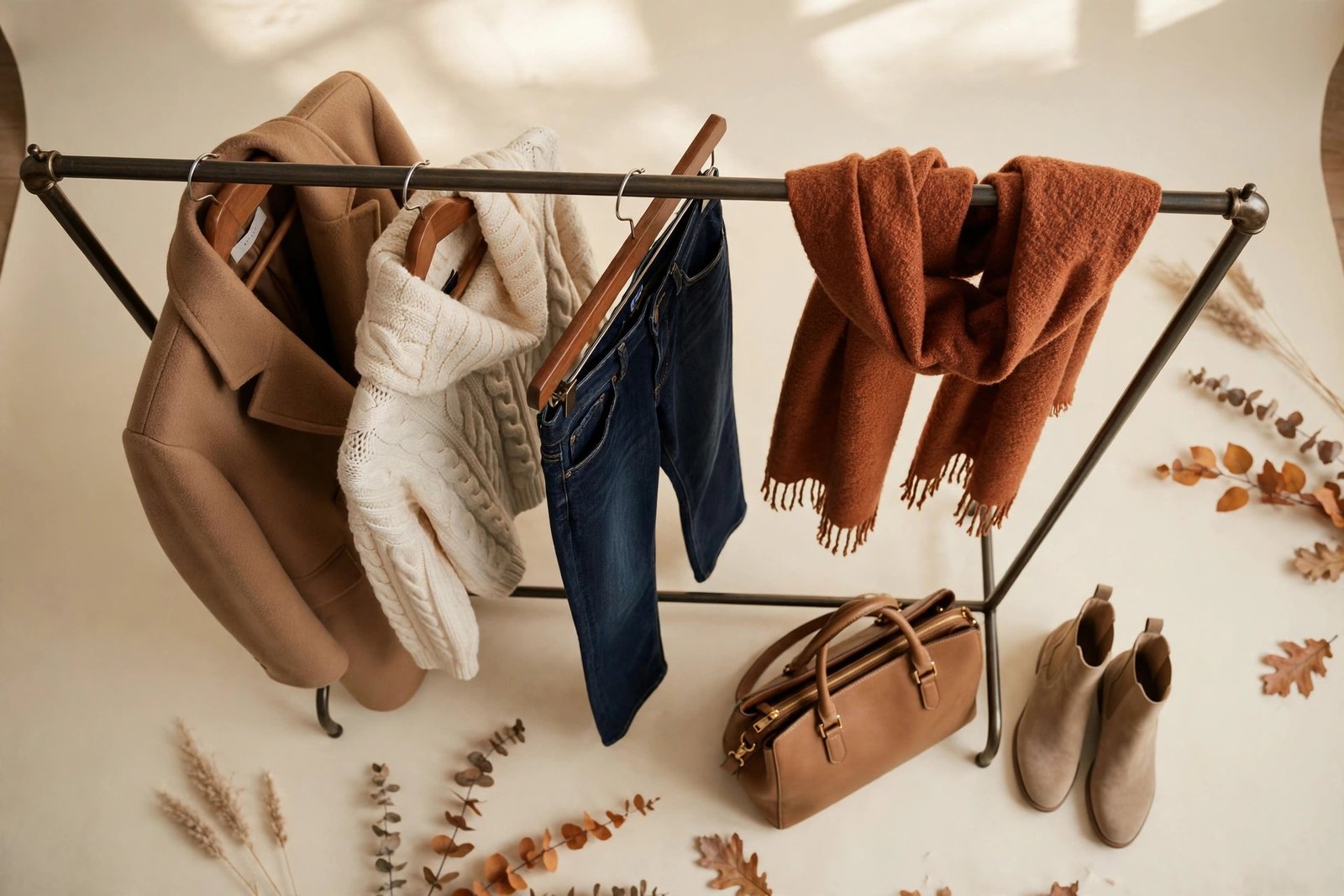
Dark jeans (60%), an ivory sweater (30%), and a rust scarf (10%). On a rushed Tuesday morning, grab any top, any bottom, and any pair of shoes from your capsule and walk out knowing you look put-together. That’s the real payoff — mornings that don’t start with a closet meltdown.
What If You Love Color and Neutrals Bore You?
Fair question. “Neutral” is a role, not a color — your neutrals can be navy, forest green, and burgundy, all deep shades that function like neutrals because they go with almost everything. The formula still works as long as everything coordinates. The only rule is cohesion — there are no rules about which colors you love.
Need inspiration? These fall outfit ideas using a capsule color palette show how to put a cohesive palette into action.
Putting It All Together: A Fall Example Palette
Let me show you what this looks like in practice. Here’s a complete fall capsule wardrobe color palette:
- Neutrals: black, ivory, camel
- Accents: rust, olive
- Wild card: a leopard-print scarf
From this palette, you could build: black trousers + ivory cable-knit sweater + rust scarf; camel coat + black jeans + olive top; black dress + camel boots + olive bag. Every combination looks intentional, and when you shop, you have a specific list — no more “close enough” purchases that never quite work.
FAQs
How many colors should a capsule wardrobe have?
Six is the sweet spot: three neutrals, two accent colors, and one wild card. This gives you enough variety to avoid boredom while keeping everything mix-and-matchable. Some people go as low as four or five; more than seven or eight and you start losing the everything-goes-with-everything benefit.
Can black and brown be in the same capsule wardrobe color palette?
Absolutely — this old rule is officially retired. Black and brown look sophisticated together, especially in rich textures like leather, wool, and suede. The key is keeping them in the same undertone family so the combination feels deliberate rather than accidental.
What if my favorite colors change with the seasons?
Totally normal. Keep the same neutral base year-round and rotate your accents — rust and burgundy for fall, blush and sage for spring. You only swap a few pieces, not the whole capsule.
Do I have to get rid of clothes that aren’t in my palette?
Not overnight. Start by identifying your palette, then notice which pieces don’t fit. Wear the outliers less, and when they wear out or you stop reaching for them, replace them with palette-friendly pieces. A capsule wardrobe is a gradual transition, not a purge.
How do I figure out which colors look good on me?
Pay attention to what gets you compliments — that’s real data. Hold fabrics up to your face in natural light: colors that make your skin look bright are keepers; colors that make you look washed out aren’t. When in doubt, make your neutrals the colors you feel most confident in.
Conclusion
A capsule wardrobe color palette is the single highest-impact thing you can do for your closet — more than decluttering, more than organizing, more than buying anything new. Six color families, chosen with intention, and suddenly every piece you own works harder.
Start this weekend. Pull out your most-worn pieces, notice the colors that repeat, and write down your 3-2-1. Then watch your mornings get easier and your style get sharper — all from deciding what colors belong in your life.
Building your capsule wardrobe color palette doesn’t have to be overwhelming. Start by auditing what you already own, then choose a capsule wardrobe color palette that reflects your lifestyle and favorite colors. The right capsule wardrobe color palette simplifies both shopping and getting dressed. Your ideal capsule wardrobe color palette starts with what you love.
For background on the minimalist fashion concept, read about the capsule wardrobe on Wikipedia. Remember that your capsule wardrobe color palette should grow and evolve with you over time.
Revisit your capsule wardrobe color palette each season and refine the accents as trends shift. A well-chosen capsule wardrobe color palette is the true foundation of effortless personal style. Once your capsule wardrobe color palette is set, mornings get easier. There’s no single perfect capsule wardrobe color palette — only the one that works for you.