Table of Contents
There’s a wrist revolution happening, and it starts with a single bold cuff. Gold cuff stacking — layering wide, sculptural gold bracelets up the forearm — is the fastest way to make any outfit look intentional. A plain white tee and jeans become an editorial moment the second you add three hammered cuffs. It’s maximalism with discipline: the pieces are bold, but the formula is simple.
The appeal is partly practical. Unlike delicate chains that tangle and vanish, cuffs are architectural — they hold their shape, they catch light, and they read from across the room. Whether you own one statement cuff or a growing collection, here’s how to stack them like you mean it.
The Anchor Cuff: Start with One Bold Piece
Every great gold cuff stacking starts with an anchor — the widest, most sculptural piece in your collection. A hammered cuff, a wide polished band, or a textured torque cuff sets the tone for everything layered beneath it. Wear it alone first to learn its personality: does it skew modern and minimal, or vintage and ornate?
Place the anchor cuff just below the wrist bone or mid-forearm, depending on your sleeve length and arm shape. Wider cuffs sit best a little higher on the forearm where they won’t fight with your wrist’s movement. One anchor is enough — two wide cuffs side by side compete instead of complement.
If you’re buying your first cuff, choose gold-toned brass or gold vermeil over plated fashion jewelry; the weight and finish difference is visible, and a good cuff gets worn weekly. Hammered finishes hide scratches beautifully, making them the smartest first investment.
Mix Textures: Hammered, Polished, Rope, and Mesh
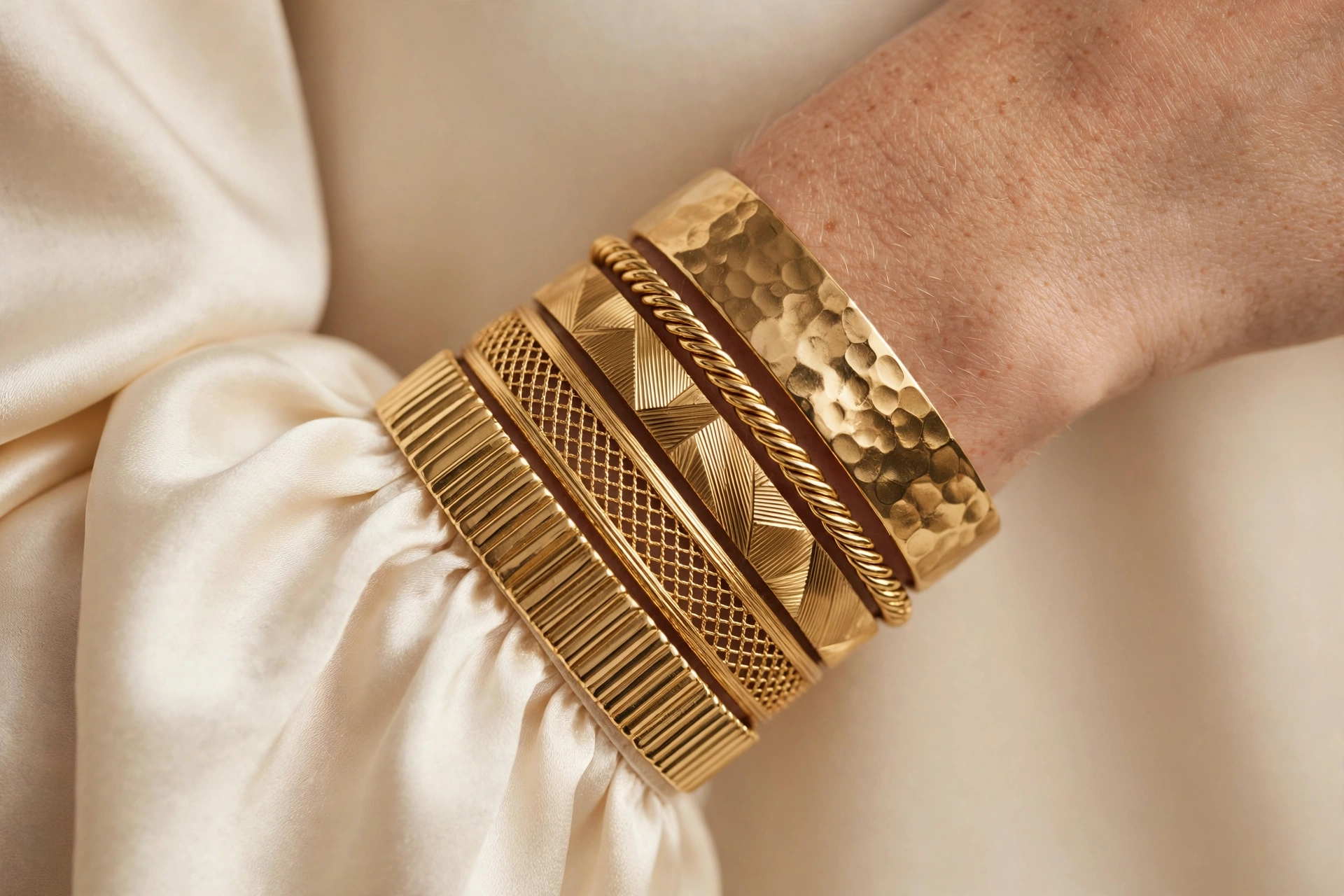
The secret to gold cuff stacking that looks collected rather than cluttered is texture contrast. Pair a hammered cuff with a smooth polished bangle, add a rope-twist cuff, then finish with a delicate mesh or chain-link bracelet. Each texture catches light differently, which creates depth — the stack looks rich even in flat office lighting.
A reliable formula: one wide textured cuff (hammered or engraved) + one slim polished bangle + one rope or braided cuff + one thin chain bracelet. Four pieces, four textures, one cohesive story. Keep them all in the same gold tone — yellow gold with yellow gold — and the variety comes from the finishes, not the colors.
Avoid stacking four identical polished bangles; without texture contrast, the stack reads flat and a little dated. If all you own are smooth bangles, add one textured cuff and the whole stack transforms.
Width Graduation: The Styling Trick That Always Works
Arrange your stack by width, graduating from widest to narrowest as you move from elbow toward wrist — or the reverse, widest at the wrist. Both directions work; the key is the deliberate gradient. A wide cuff at the wrist with progressively slimmer bangles trailing up the forearm creates a beautiful taper that elongates the arm.
Leave small gaps between pieces rather than jamming them edge to edge. A millimeter or two of skin between cuffs keeps the stack from looking like a single armored sleeve and lets each piece breathe. This also prevents the clanking that makes stacked wrists annoying in quiet offices.
For petite wrists, keep the widest cuff under an inch and limit the stack to three pieces — proportion matters more than quantity. For broader wrists, go bolder: a two-inch cuff is your anchor, not your statement.
One Wrist or Two? The Balance Question
The classic move is one fully stacked wrist and a bare (or single-piece) opposite wrist. This asymmetry looks deliberate and keeps the look from overwhelming the outfit. Pair the stacked wrist with a watch or a single slim bangle on the other side if bare feels too empty.
Two stacked wrists can work, but only when the stacks are uneven — say, three cuffs on the right and one slim bangle on the left. Mirror-image stacks on both wrists read costume-y and fight with sleeves. When in doubt, commit to one wrist and let it be the moment.
Also consider your dominant hand: stacks on the wrist you write or type with will clack against desks and get scuffed faster. Many women stack the non-dominant wrist for comfort and keep the dominant one minimal.
What to Wear with Gold Cuff Stacking
Cuffs love sleeves that show them off. Push up the sleeves of an oversized blazer, a chunky knit, or a crisp button-down to display the stack — the contrast between soft fabric and hard gold is the whole point. Sleeveless tops and dresses are natural partners, especially in evening looks where the cuffs double as your statement jewelry.
Neckline rule: with a bold wrist stack, keep the neckline quiet. A simple pendant or bare neck balances the visual weight. If you’re wearing statement earrings too, choose one — bold ears plus a bold wrist is a lot for daytime. Evening is more forgiving.
Color-wise, gold cuffs flatter everything but sing against black, cream, camel, deep green, and burgundy. A cream silk blouse with a gold cuff stack is one of the most polished combinations in existence — minimal effort, maximum polish.
Mixing Metals: When to Break the All-Gold Rule
Purists keep gold cuff stacking all-gold, and it’s the safest route. But a single contrasting piece — a silver bangle or a black enamel cuff slipped into the middle of the stack — can add modern edge. The rule: one outsider maximum, and keep it slim. The gold should clearly dominate.
Rose gold mixes more easily with yellow gold than silver does, since they share warmth. If you own pieces across metals, group them by wrist — all gold on one, mixed metals on the other — rather than blending everything into one stack.
Care and Keeping: Make Your Stack Last
Stacked cuffs knock against each other, so expect wear. Store each cuff separately in a soft pouch to prevent scratching, and put your stack on after perfume, lotion, and hairspray — chemicals dull gold finishes fast. Wipe pieces with a soft dry cloth after wearing; it takes ten seconds and doubles the time between proper cleanings.
For vermeil and gold-filled cuffs, avoid water — take the stack off before swimming or showering. Solid brass cuffs can develop a patina; if you like the aged look, let it happen, but polish selectively — a bright anchor cuff with softly aged supporting pieces is a beautiful combination.
If you’re expanding your gold jewelry wardrobe, our chunky gold jewelry guide covers necklaces and earrings in the same spirit — and our brooch styling guide is perfect if you’re leaning into the maximalist accessories trend. For the broader history of the form, the bracelet entry traces cuffs back thousands of years.
FAQs
How many gold cuffs should I stack at once?
Three to five pieces is the sweet spot for most wrists — one wide anchor cuff plus two to four slimmer supporting pieces. Fewer than three reads as “bracelets,” not a stack; more than five gets uncomfortable and starts to look like armor.
Can I stack gold cuffs with a watch?
Yes, and it looks great. Wear the watch on the opposite wrist from your stack, or integrate a slim watch into the stack itself — place it at the wrist with cuffs trailing up the forearm. A gold-tone watch blends seamlessly; a leather-strap watch adds nice texture contrast.
Do gold cuffs suit small wrists?
Absolutely — just scale down. Choose an anchor cuff no wider than an inch, keep the total stack to three pieces, and favor slim profiles. A petite wrist with a well-proportioned stack looks elegant, not overwhelmed.
What’s the difference between gold vermeil, gold-filled, and plated cuffs?
Vermeil is sterling silver with a thick gold layer — durable and good value. Gold-filled has an even thicker gold layer bonded to a base metal and wears well for years. Standard plating is thinnest and wears off fastest, especially on cuffs that knock together. For pieces you’ll stack weekly, vermeil or gold-filled is worth the upgrade.
Can I wear gold cuff stacking to the office?
Yes — keep the stack to three pieces with one anchor cuff, and avoid anything that jangles loudly. A polished, controlled stack reads as confident and put-together in professional settings. Save the five-piece maximalist version for evenings and weekends.
Gold cuff stacking works because it’s both bold and formulaic — anchor, texture contrast, width graduation, one wrist. Learn the formula once and you’ll reach for your cuffs the way you reach for your favorite lipstick: automatically, and always to good effect.